Libya: Republic and People's Republic (1969-present)
An illustrated key to Libyan revenues since 1943 can be found here
Chapter overview
Currency:
(1969) 1 Libyan pound = 1000 millièmes
(1972) 1 dinar (d) = 1000 dirhams (dh)
Note: the official name of the country since 1976 has been Great Socialist People's Libyan Arab Jamahiriya. The last word - an Arabic term generally translated as state of the masses - was a neologism coined by Muammar al-Gaddafi, meaning something like people's republic.
No Libyan revenue stamps of the post-Gaddafi era have surfaced to date (April 2012).
Chapter overview
- Airport Tax (catalogue numbers prefixed A)
- Consular (catalogue numbers prefixed C)
- Medical Fee (catalogue numbers prefixed E)
- Municipal (catalogue numbers prefixed M)
- Revenue (catalogue numbers prefixed R)
- War Tax (catalogue numbers prefixed W)
Currency:
(1969) 1 Libyan pound = 1000 millièmes
(1972) 1 dinar (d) = 1000 dirhams (dh)
Note: the official name of the country since 1976 has been Great Socialist People's Libyan Arab Jamahiriya. The last word - an Arabic term generally translated as state of the masses - was a neologism coined by Muammar al-Gaddafi, meaning something like people's republic.
No Libyan revenue stamps of the post-Gaddafi era have surfaced to date (April 2012).
Airport Tax
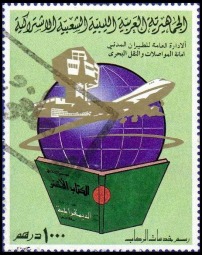
A1
c1980. Aircraft and terminal, globe and book. Inscribed Libyan Arab Republic at top, value in Arabic numerals at lower left. 41½ x 54 mm. Perf 13½. No watermark. Multicoloured; background colour given.
A1. 1000dh grey-green
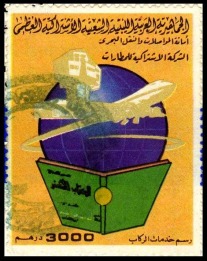 A2 |
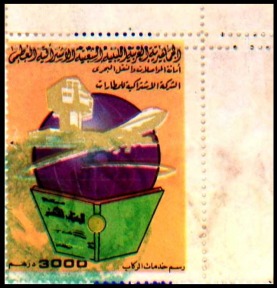 A2a |
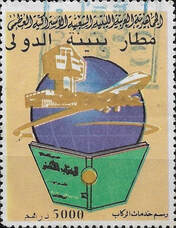
A3
|
c1985. As A1 but inscription at top changed to Great Socialist People’s Libyan Arab Jamahiriya, and value in Western numerals at lower left. 41½ x 53½ mm. Perf 10½. No watermark. Multicoloured; background colour given.
A2. 3000dh yellow-orange
a. Extra row of perforations at top
A3. 5000dh yellow-brown
Note: A3 is inscribed Benina International Airport.
A2. 3000dh yellow-orange
a. Extra row of perforations at top
A3. 5000dh yellow-brown
Note: A3 is inscribed Benina International Airport.
Consular
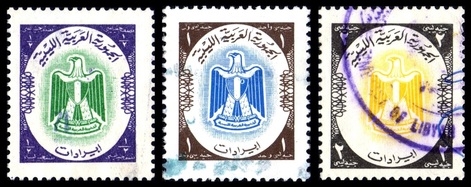
C101/103
1970 (earliest recorded usage). Arms of Libya showing the Eagle of Saladin facing left. Inscribed Libyan Arab Republic at top and Revenue at foot, with currency in Libyan pounds. 22 x 26½ mm with wide margins all round. Perf 11½. No watermark.
C101. £L½ green and deep blue
C102. £L1 blue and brown
C103. £L2 yellow and black
C101. £L½ green and deep blue
C102. £L1 blue and brown
C103. £L2 yellow and black
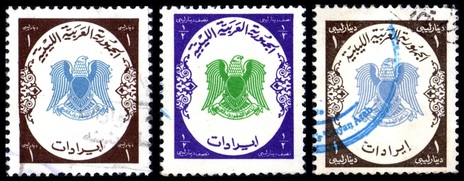
C111 and C116/7
1980 (earliest recorded usage). Arms of Libya redrawn showing the Hawk of Qureish facing right, and change to new currency (dinars). Inscribed Libyan Arab Republic at top and Federation of Arab Republics on the scroll held by the hawk. 23 x 28 mm. Perf 11½. No watermark.
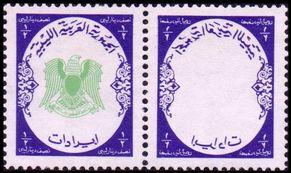
C116a (on right, se-tenant with normal)
a) Figure of value below text in all four corners
C111. 1d blue and deep brown
b) Figure of value now above text in lower corners, the 1d redrawn with clearer inscriptions
C116. ½d green and violet
a. Centre omitted and frame reversed
C117. 1d blue and deep brown
Note: The Federation of Arab Republics was an affilation of Libya, Egypt, and Syria, which began in January 1972 and lasted for nearly six years. Although the Federation officially ended in November 1977, Libya's Consular and War Tax stamps continued to show the Federation's Coat of Arms until well into the 1990s.
C111. 1d blue and deep brown
b) Figure of value now above text in lower corners, the 1d redrawn with clearer inscriptions
C116. ½d green and violet
a. Centre omitted and frame reversed
C117. 1d blue and deep brown
Note: The Federation of Arab Republics was an affilation of Libya, Egypt, and Syria, which began in January 1972 and lasted for nearly six years. Although the Federation officially ended in November 1977, Libya's Consular and War Tax stamps continued to show the Federation's Coat of Arms until well into the 1990s.
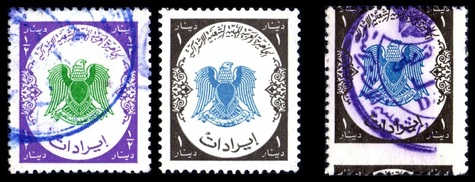
C121/2 plus misperforated example of C122 (see footnote)
1982-84 (earliest recorded usage). As C116/7 but Arabic inscription at top changed to Great Socialist People’s Libyan Arab Jamahiriya. 23 x 28 mm. Perf 11½. No watermark.
C121. ½d green and violet
C122. 1d blue and deep brown
Note: several examples of C122 are known with a vertical perforation shift of about 3mm, all used in Bangladesh. These appear to be genuine.
C121. ½d green and violet
C122. 1d blue and deep brown
Note: several examples of C122 are known with a vertical perforation shift of about 3mm, all used in Bangladesh. These appear to be genuine.
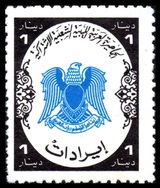
C131
1986 (earliest recorded usage). As previous issue but value now shown in Western numerals. 23½ x 28½ mm. Perf 11½. No watermark.
C131. 1d blue and deep brown
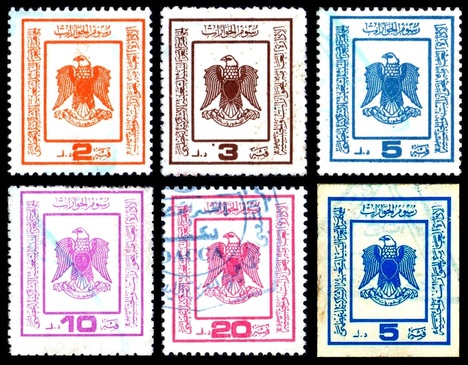
C142/6 and C164
1988-2002. New type with eagle facing left, inscribed Passport Fees at top. 23½ x 28½ mm. Perf 11½. The dates in brackets are the earliest recorded usage for each value.
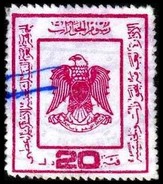
Forgery with saw-tooth perfs
a) No watermark, perf 11½
C142. 2d orange (1991)
C143. 3d brown (1989)
C144. 5d blue (1989)
C145. 10d mauve (1988)
C146. 20d rose-carmine (1994)
b) No watermark, roulette 10, self-adhesive
C164. 5d blue
c) Watermark Multiple Coat of Arms, perf 11½
C174. 5d blue
C175. 10d mauve
C176. 20d rose-carmine
Notes:
1. The earliest dated examples of C142/6 are all rough perf, with clean-cut printings appearing from 1997 (2d and 20d), 1998 (5d) and 1999 (10d). The 3d has not been recorded with clean-cut perf.
2. A stamp similar to C146 but with a saw-tooth perforation measuring 14½ was formerly listed here but is now thought to be a forgery intended to defraud the Libyan authorities. Examples are similar in size and shade to the genuine stamp and the overall impression is well executed. The only recorded usage of these stamps is on passport pages cancelled in Dacca (Bangladesh), suggesting that this may have been the place of their manufacture.
3. The watermark is found upright on all three values (C174/6) and is also known inverted on the 5d and 10d.
C142. 2d orange (1991)
C143. 3d brown (1989)
C144. 5d blue (1989)
C145. 10d mauve (1988)
C146. 20d rose-carmine (1994)
b) No watermark, roulette 10, self-adhesive
C164. 5d blue
c) Watermark Multiple Coat of Arms, perf 11½
C174. 5d blue
C175. 10d mauve
C176. 20d rose-carmine
Notes:
1. The earliest dated examples of C142/6 are all rough perf, with clean-cut printings appearing from 1997 (2d and 20d), 1998 (5d) and 1999 (10d). The 3d has not been recorded with clean-cut perf.
2. A stamp similar to C146 but with a saw-tooth perforation measuring 14½ was formerly listed here but is now thought to be a forgery intended to defraud the Libyan authorities. Examples are similar in size and shade to the genuine stamp and the overall impression is well executed. The only recorded usage of these stamps is on passport pages cancelled in Dacca (Bangladesh), suggesting that this may have been the place of their manufacture.
3. The watermark is found upright on all three values (C174/6) and is also known inverted on the 5d and 10d.
Medical fee
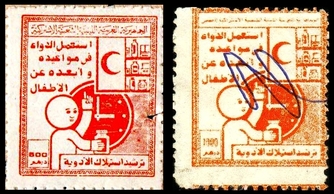
L1/2
1980s? Person with medicines and clock. Inscribed Great Socialist People’s Libyan Arab Jamahiriya at top, value in Western numerals at lower left. 24 x 29 mm. Perf 11½ (500dh rough perf). No watermark.
L1. 500dh orange
L2. 1000dh orange
The inscription above middle left seems to be a warning to keep medicines out of the reach of children. The top inscription differs between the two values but the printing is too small to be legible.
L1. 500dh orange
L2. 1000dh orange
The inscription above middle left seems to be a warning to keep medicines out of the reach of children. The top inscription differs between the two values but the printing is too small to be legible.
Municipal
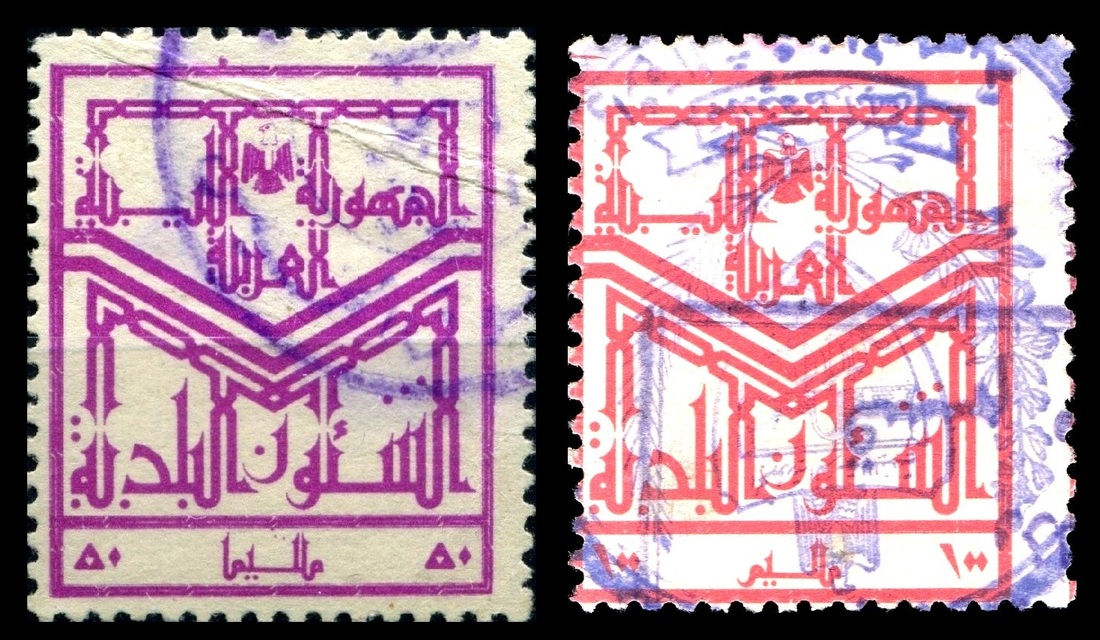
M71/72
1973-75 (recorded usage). 25 x 30 mm. Calligraphy, featuring small image of Eagle of Saladin facing left. Inscribed Libyan Arab Republic in upper panel, Municipal Affairs at foot, with currency in millièmes. Perf 11½ (50m) or 10½ (100m). No watermark.
M71. 50m bright purple
M72. 100m carmine
M73. 200m black
Recorded usage:
M71. 50m bright purple
M72. 100m carmine
M73. 200m black
Recorded usage:
- M71 - 7/6/73 to 31/12/75

M81/83 (top), M91/92 (bottom left), M102/104 (bottom right)
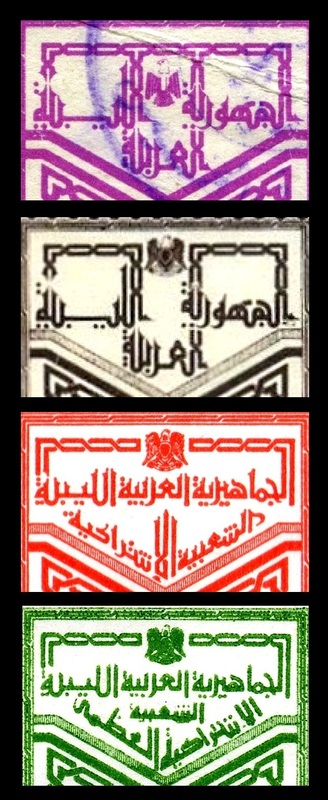 The four types compared - M71/3, M81/3, M91/2, M102/4 (top to bottom)
1975-81 (recorded usage). Similar to previous issue but now with Hawk of Qureish facing right, and currency changed to dirhams. Perf 11½. No watermark. Three different types.
a) Libyan Arab Republic in upper panel (1975-77)
M81. 50dh bright purple
M82. 100dh carmine
M83. 200dh black
b) Socialist People’s Libyan Arab Jamahiriya in upper panel, with a long unbroken line of text below the hawk (1979-87)
M91. 50dh bright purple
M92. 100dh orange-red
c) Value now shown in Western numerals, and upper panel again changed to incorporate the Arabic word Great in the country name; rough perf (c1990s)
M102. 100dh vermilion
M104. 500dh green
Recorded usage:
a) Libyan Arab Republic in upper panel (1975-77)
M81. 50dh bright purple
M82. 100dh carmine
M83. 200dh black
b) Socialist People’s Libyan Arab Jamahiriya in upper panel, with a long unbroken line of text below the hawk (1979-87)
M91. 50dh bright purple
M92. 100dh orange-red
c) Value now shown in Western numerals, and upper panel again changed to incorporate the Arabic word Great in the country name; rough perf (c1990s)
M102. 100dh vermilion
M104. 500dh green
Recorded usage:
- M81 - 31/12/75 to 3/3/77
- M91 - 9/7/79 to 10/6/81
- M92 - 7/3/87
Revenue
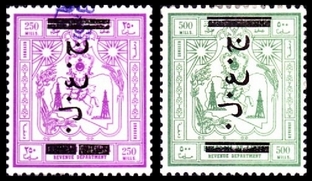
R107/8 (other images to be added)
c1970? Oil wells types of Libya (Kingdom Federal issues) overprinted with the Arabic initials for Libyan Arab Republic (sideways, reading downwards from right to left), and black bars cancelling the Kingdom of Libya inscriptions at top and bottom.
R101. 5m green
R102. 10m violet
R104. 30m red-orange
R105. 50m grey-black
R106. 100m brown
R107. 250m bright purple
R108. 500m green
R101. 5m green
R102. 10m violet
R104. 30m red-orange
R105. 50m grey-black
R106. 100m brown
R107. 250m bright purple
R108. 500m green
Note: R113/223 are all based on the same design of a central octagon with rounded edges, surrounded by four rectangular panels. The top and bottom panels give the country name and value respectively, while the side panels describe the appropriation.
The various types can be difficult to distinguish, but the following three main sub-divisions should help with identification:
- One line of Arabic in top panel - see R113/157
- Two lines of Arabic in top panel, Arabic numerals in bottom panel - see R162/178
- Two lines of Arabic in top panel, Western numerals in bottom panel - see R181/223
An illustrated key to all the sub-types can be found here.
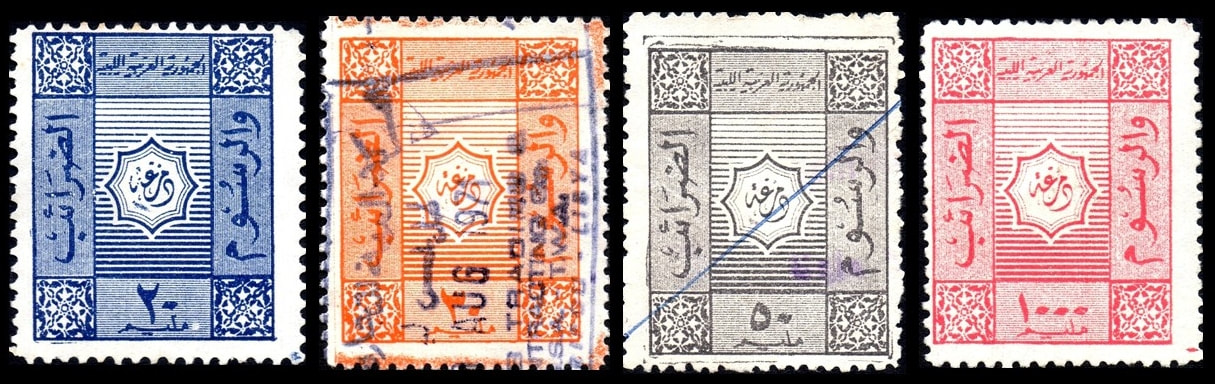
R113/118
1970-78 (recorded usage). Inscribed The Libyan Arab Republic at top (one line of Arabic). Figures of value in Arabic only. No watermark. Initial printing (R113/118) in large format 25½ x 32½ mm; all subsequent printings approx 23½ x 29 mm.
a) Side panels inscribed Taxes and Fees; currency in millièmes, large format (25½ x 32½ mm), perf 10½-11 (November 1970 to November 1971)
R113. 20m deep blue
R114. 30m red-orange
R115. 50m grey-black
R118. 1000m rose-carmine
a) Side panels inscribed Taxes and Fees; currency in millièmes, large format (25½ x 32½ mm), perf 10½-11 (November 1970 to November 1971)
R113. 20m deep blue
R114. 30m red-orange
R115. 50m grey-black
R118. 1000m rose-carmine
R121/127
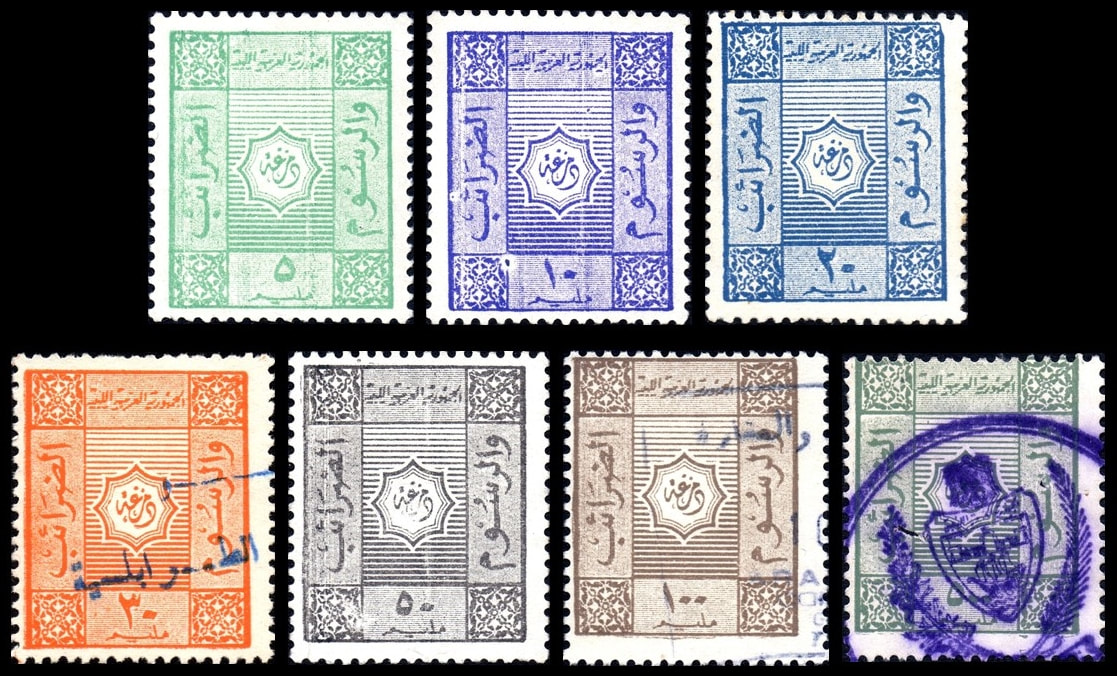
b) Currency in millièmes, small format (23½ x 29½ mm), perf 11½ (Jan 1971 to March 1975)
R121. 5m green
R122. 10m violet
R123. 20m blue
R124. 30m red-orange
R125. 50m grey-black
R126. 100m brown
R127. 500m grey-green
R121. 5m green
R122. 10m violet
R123. 20m blue
R124. 30m red-orange
R125. 50m grey-black
R126. 100m brown
R127. 500m grey-green
R131/136
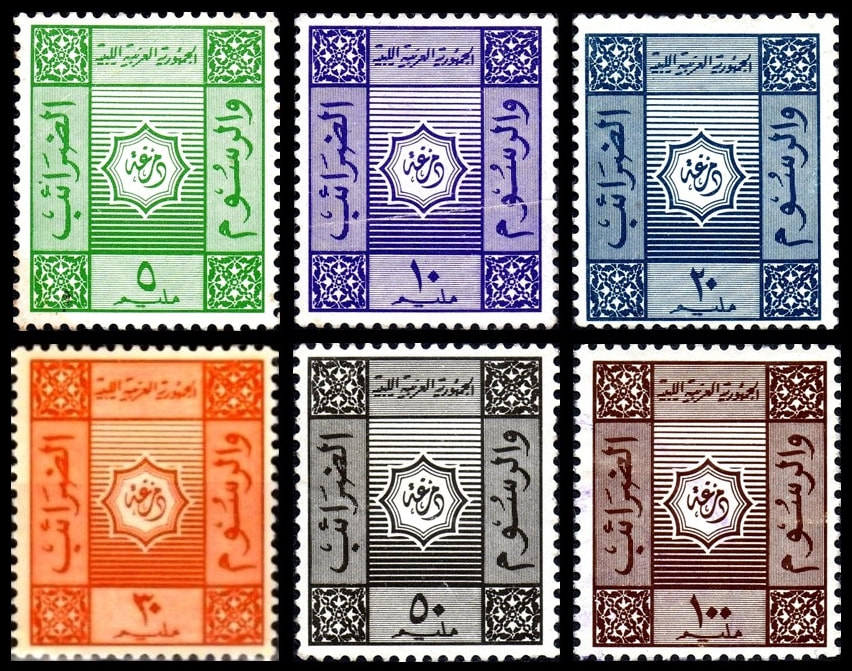
c) As b) but photo printing on shiny paper, perf 12 (1972 to March 1973)
R131. 5m bright green
R132. 10m violet
R133. 20m deep blue
R134. 30m red-orange
R135. 50m black
R136. 100m purple-brown
R131. 5m bright green
R132. 10m violet
R133. 20m deep blue
R134. 30m red-orange
R135. 50m black
R136. 100m purple-brown
R141/149
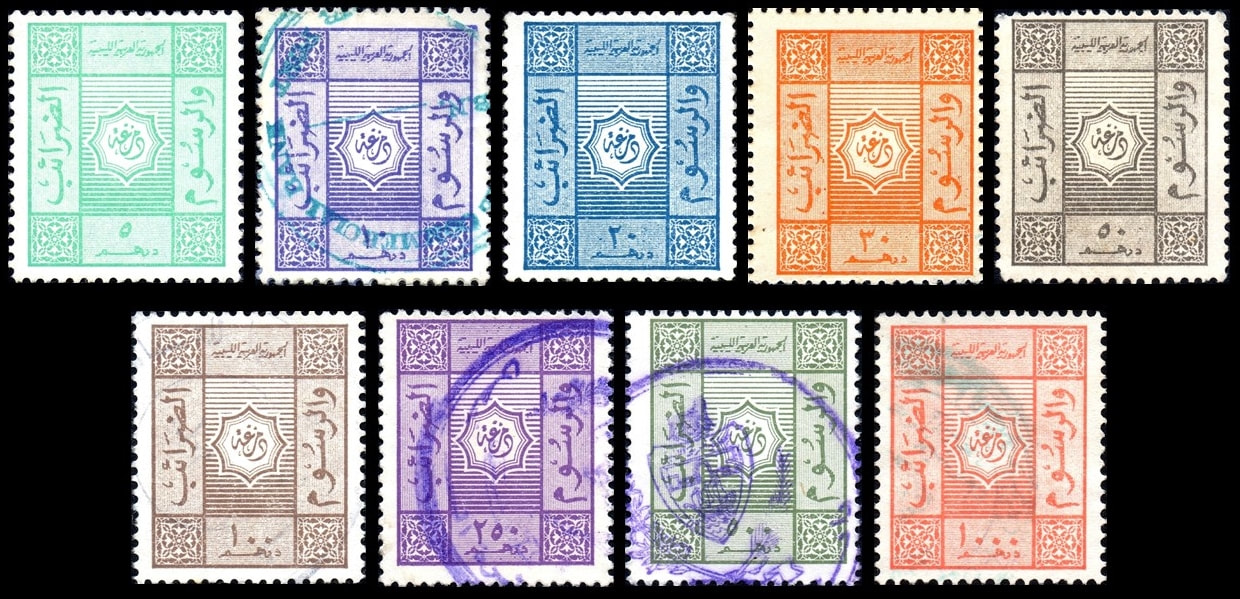
d) As b) but currency changed to dirhams (June 1973 to August 1976)
R141. 5dh green
R142. 10dh violet
R143. 20dh blue
R144. 30dh red-orange
R145. 50dh grey
R146. 100dh brown
R147. 250dh purple
R148. 500dh grey-green
R149. 1000dh rose
Note: R144 is known with either rough or clean-cut perfs.
R141. 5dh green
R142. 10dh violet
R143. 20dh blue
R144. 30dh red-orange
R145. 50dh grey
R146. 100dh brown
R147. 250dh purple
R148. 500dh grey-green
R149. 1000dh rose
Note: R144 is known with either rough or clean-cut perfs.
R152/157
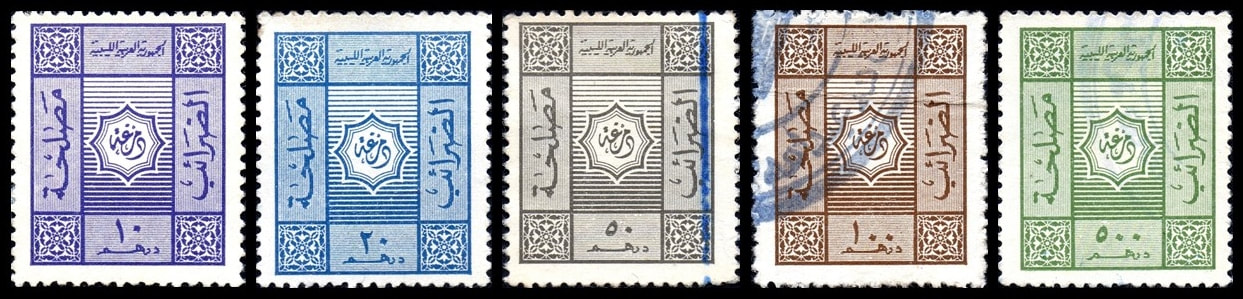
e) As d) but side panels inscribed Department of Taxes (August 1977 to August 1978)
R152. 10dh violet
R153. 20dh blue
R155. 50dh grey
R156. 100dh brown
R157. 500dh grey-green
R152. 10dh violet
R153. 20dh blue
R155. 50dh grey
R156. 100dh brown
R157. 500dh grey-green
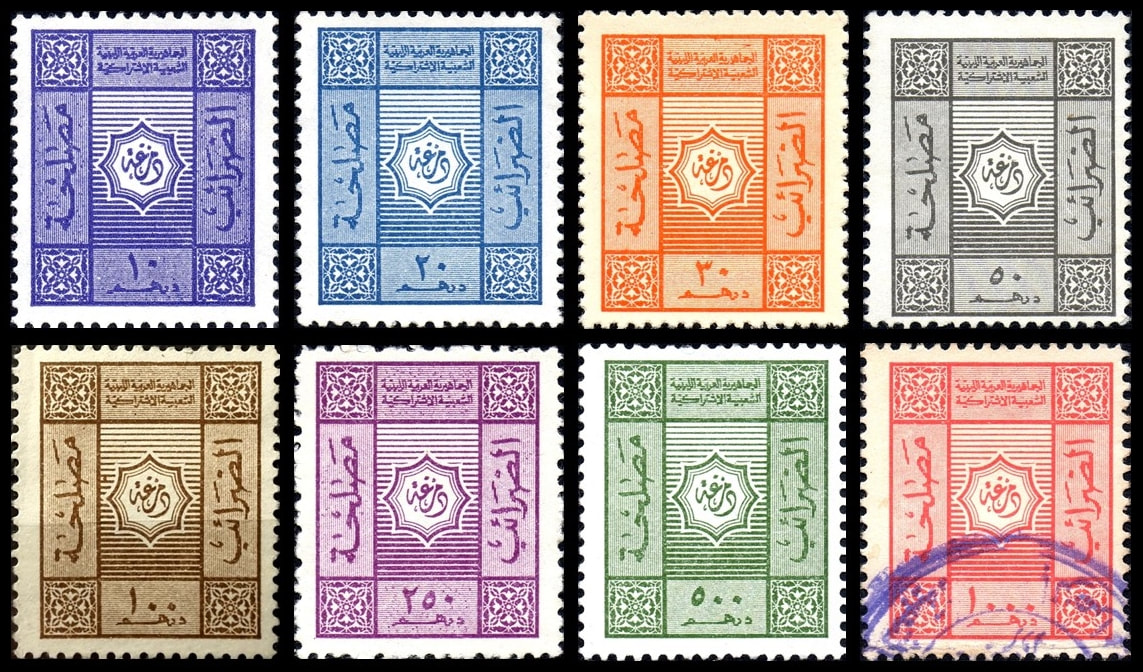
R162/169
1979-80s (earliest recorded usage). As previous issues but country name in top panel changed to Socialist People’s Libyan Arab Jamahiriya in two lines, with figures of value in Arabic only. 23½ x 29 mm. Perf 11½. No watermark.
a) Side panels inscribed Department of Taxes
R162. 10dh violet
R163. 20dh blue
R164. 30dh red-orange
R165. 50dh grey
R166. 100dh brown
R167. 250dh purple
R168. 500dh grey-green
R169. 1000dh carmine
a) Side panels inscribed Department of Taxes
R162. 10dh violet
R163. 20dh blue
R164. 30dh red-orange
R165. 50dh grey
R166. 100dh brown
R167. 250dh purple
R168. 500dh grey-green
R169. 1000dh carmine
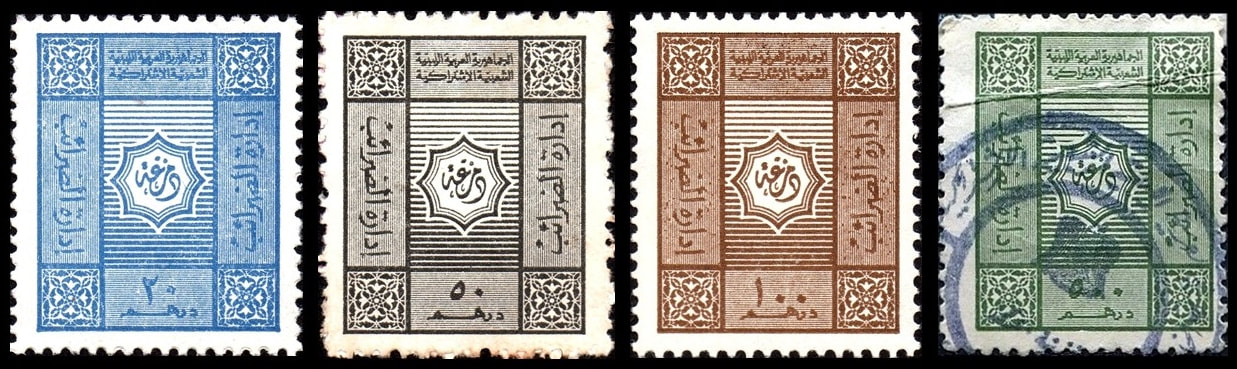
R173/178
b) Side panels inscribed Bureau of Taxes (both sides the same)
R173. 20dh blue
R175. 50dh black
R176. 100dh brown
R178. 500dh grey-green
Note: for a stamp similar to R173 but larger (28 x 35 mm) and imperforate, see under stamp paper xxx.
R173. 20dh blue
R175. 50dh black
R176. 100dh brown
R178. 500dh grey-green
Note: for a stamp similar to R173 but larger (28 x 35 mm) and imperforate, see under stamp paper xxx.
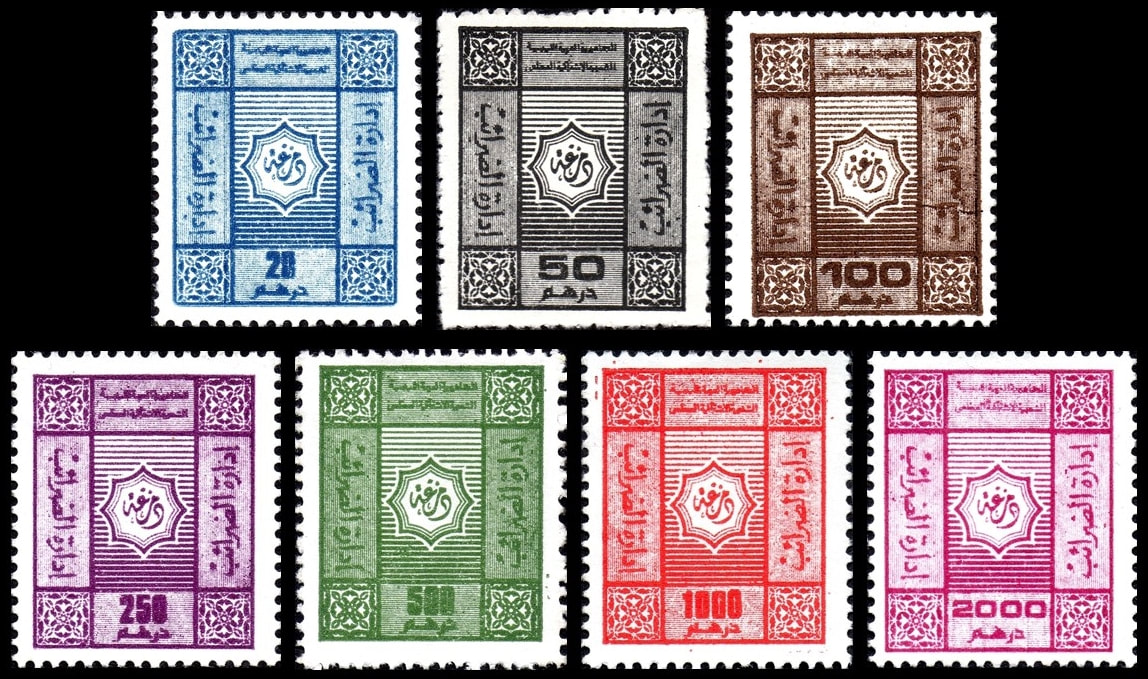
R181/187
1993-1990s (recorded usage). As R162/178 but value shown in Western numerals, and top panel inscription slightly redrawn (the Arabic word Great added at lower left). 23½ x 28½ mm. Perf 11½. No watermark (for watermarked stamps see R202ff).
a) Side panels inscribed Bureau of Taxes (both sides the same) (1993)
R181. 20dh blue
R182. 50dh grey-black
R183. 100dh brown-purple
R184. 250dh bright purple
R185. 500dh deep green
R186. 1000dh carmine
R187. 2000dh magenta
a) Side panels inscribed Bureau of Taxes (both sides the same) (1993)
R181. 20dh blue
R182. 50dh grey-black
R183. 100dh brown-purple
R184. 250dh bright purple
R185. 500dh deep green
R186. 1000dh carmine
R187. 2000dh magenta
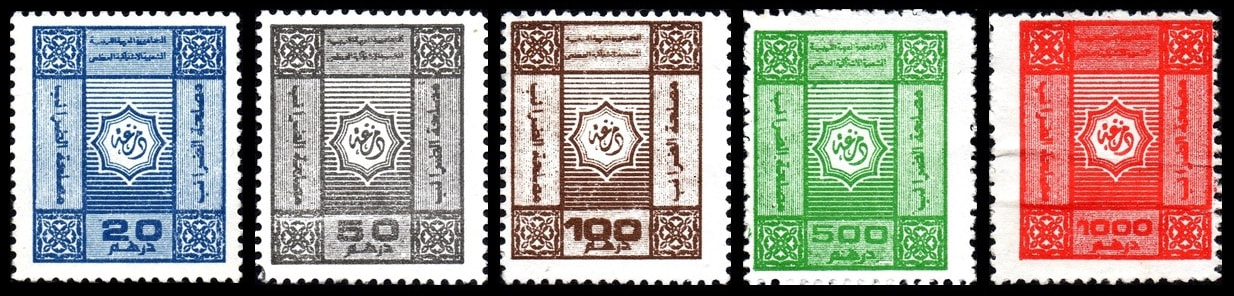
R191/196
b) Side panels inscribed Department of Taxes (both sides the same) (1987-90s)
R191. 20dh indigo
R192. 50dh grey-black
R193. 100dh brown-purple
R195. 500dh bright green
R196. 1000dh carmine
Notes:
1. The figures of value are narrow on R181 and R184/6, and wide on R182/3 and R178/196.
2. R181/193 exist with clean-cut perforations; R195/6 are known only with rough perfs. R181/3 and R185/6 exist with both clean-cut and rough perfs.
R191. 20dh indigo
R192. 50dh grey-black
R193. 100dh brown-purple
R195. 500dh bright green
R196. 1000dh carmine
Notes:
1. The figures of value are narrow on R181 and R184/6, and wide on R182/3 and R178/196.
2. R181/193 exist with clean-cut perforations; R195/6 are known only with rough perfs. R181/3 and R185/6 exist with both clean-cut and rough perfs.
R202/207
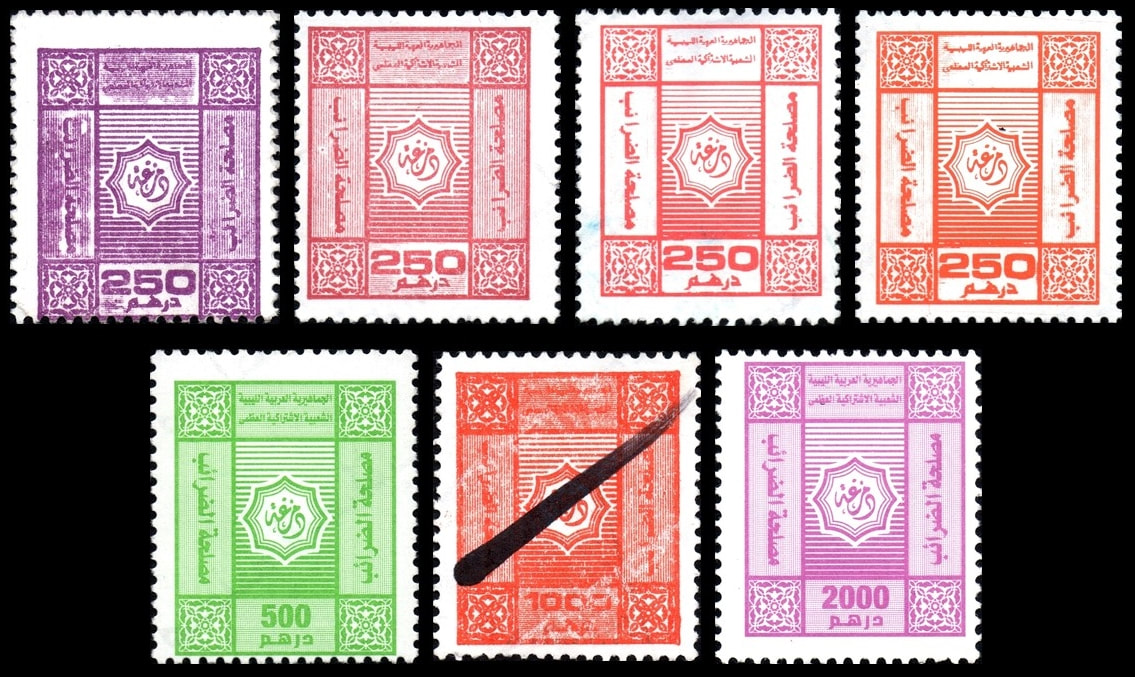
c2000s. As R181/196a but with diagonal Arabic script watermark, some types also redrawn. Perf 11½. Side panels inscribed Department of Taxes (both sides the same)
a) Side panel inscriptions as R191/196; 23½ x 28½ mm
R202. 250dh bright purple
a. Claret
b. Rose-red
c. Orange-red
R205. 500dh bright green
R206. 1000dh carmine
R207. 2000dh magenta
Notes:
1. The shades of the 250dh are easy to distinguish; in addition R202b/c have little or no shading in the inscription panels, in contrast with R202/a.
2. The figures of value are narrow on R205 and R207 and wide on the rest.
a) Side panel inscriptions as R191/196; 23½ x 28½ mm
R202. 250dh bright purple
a. Claret
b. Rose-red
c. Orange-red
R205. 500dh bright green
R206. 1000dh carmine
R207. 2000dh magenta
Notes:
1. The shades of the 250dh are easy to distinguish; in addition R202b/c have little or no shading in the inscription panels, in contrast with R202/a.
2. The figures of value are narrow on R205 and R207 and wide on the rest.
R211, R211a, R213
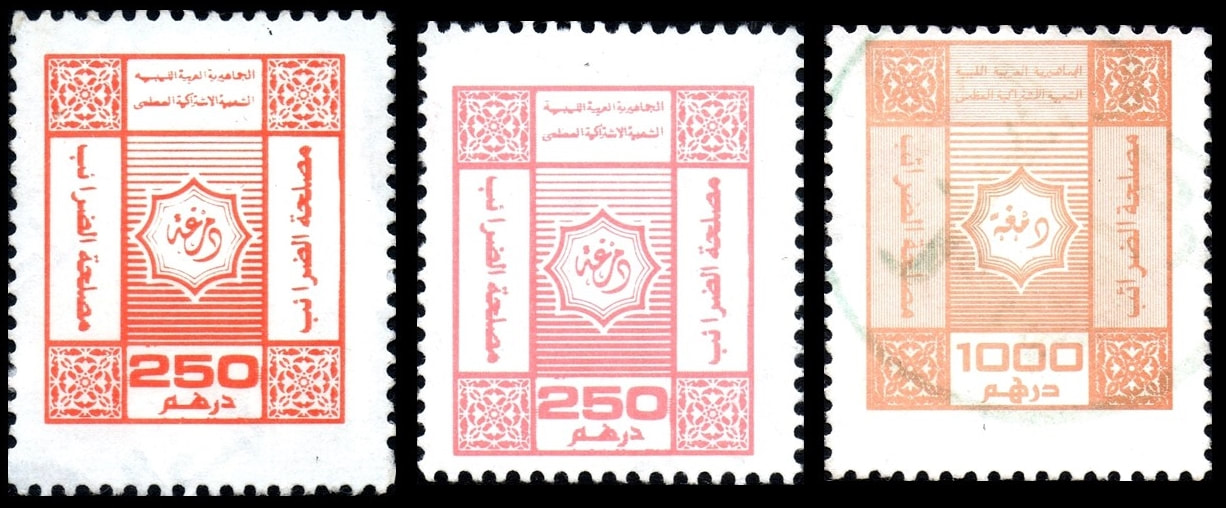
b) As R202/207 but smaller (22 x 27 mm)
R211. 250dh orange-red
a. Rose
R213. 1000dh pale rose
R211. 250dh orange-red
a. Rose
R213. 1000dh pale rose
R215/217 and R223
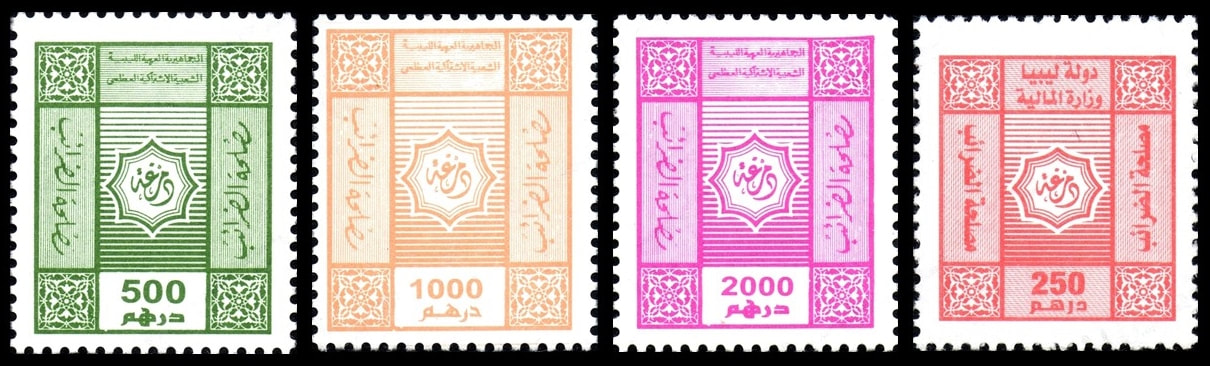
c) Side panel inscriptions in sharper lettering; 24 x 29½ mm (100dh) or 23½ x 29 mm (others)
R215. 500dh grey-green
R216. 1000dh pale orange-red
R217. 2000dh bright purple
d) Top inscription changed to State of Libya Ministry of Finance; 23 x 26 mm (c2018)
R223. 250dh orange-red
Note: The issue date of R223 is unknown but the country name inscription suggests no earlier than January 2018.
R215. 500dh grey-green
R216. 1000dh pale orange-red
R217. 2000dh bright purple
d) Top inscription changed to State of Libya Ministry of Finance; 23 x 26 mm (c2018)
R223. 250dh orange-red
Note: The issue date of R223 is unknown but the country name inscription suggests no earlier than January 2018.
War Tax
Note: the adhesives listed under this heading were formerly categorised as Consular stamps on the grounds that they are almost always found used on passport pages. However the Arabic inscription at the foot of the stamps (rasm al-jihad) is best translated as War Tax, which in the context of 1970s-80s Libya probably meant a relief fund to aid victims of the Israeli-Palestinian conflict.
Note: the adhesives listed under this heading were formerly categorised as Consular stamps on the grounds that they are almost always found used on passport pages. However the Arabic inscription at the foot of the stamps (rasm al-jihad) is best translated as War Tax, which in the context of 1970s-80s Libya probably meant a relief fund to aid victims of the Israeli-Palestinian conflict.
W101
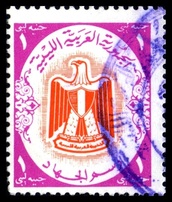
1970 (earliest recorded usage). Arms of Libya showing Eagle of Saladin facing left, similar to Consular C101/2 but design 24 x 29 mm with narrower margins. Inscribed Libyan Arab Republic at top and War Tax at foot. Perf 11½. No watermark.
W101. £L1 orange and magenta
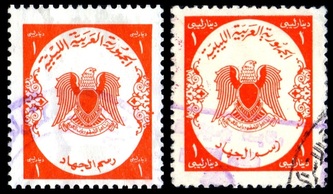
1980. Arms of Libya redrawn showing Hawk of Qureish facing right. Inscribed Libyan Arab Republic at top and Federation of Arab Republics on the scroll held by the hawk. 23 x 28 mm. Perf 11½. No watermark.
W111 and W116
a) Figure of value below text in all four corners
W111. 1d orange
b) Redrawn type with clearer inscriptions, figure of value now above text in lower corners
W116. 1d red-orange
Note: concerning the Federation of Arab Republics inscription, see footnote below C111/7.
W111. 1d orange
b) Redrawn type with clearer inscriptions, figure of value now above text in lower corners
W116. 1d red-orange
Note: concerning the Federation of Arab Republics inscription, see footnote below C111/7.
Two examples of W121 showing clean-cut and rough perfs
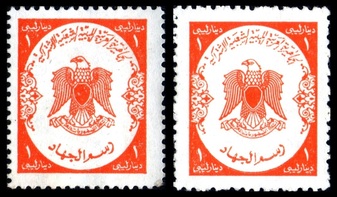
1982-84 (earliest recorded usage). As previous issue but Hawk facing left, and Arabic inscription at top changed to Great Socialist People’s Libyan Arab Jamahiriya. 23 x 28 mm. Perf 11½. No watermark.
W121. 1d orange
Notes:
1. Specialists may wish to distinguish clean-cut and rough perf varieties of W121, though the difference is no longer considered significant enough for a separate catalogue listing.
2. Stamps as W121 but with a saw-tooth perforation are now regarded as forgeries. For further details, see footnote 2 below C164.
3. It will be noticed that W101, W111/6 and W121 correspond to Consular issues C101/3, C111/7 and C121/2 respectively. The latest Consular issues of Libya (C131/64 with value in Western numerals) have no equivalent War Tax stamps, which suggests that the use of War Tax stamps may have ceased in the late 1980s or 90s.
W121. 1d orange
Notes:
1. Specialists may wish to distinguish clean-cut and rough perf varieties of W121, though the difference is no longer considered significant enough for a separate catalogue listing.
2. Stamps as W121 but with a saw-tooth perforation are now regarded as forgeries. For further details, see footnote 2 below C164.
3. It will be noticed that W101, W111/6 and W121 correspond to Consular issues C101/3, C111/7 and C121/2 respectively. The latest Consular issues of Libya (C131/64 with value in Western numerals) have no equivalent War Tax stamps, which suggests that the use of War Tax stamps may have ceased in the late 1980s or 90s.
Note: an illustrated key to Libyan revenues since 1943 can be found here
