Trucial States
Note: The stamps listed in this chapter were used to pay judicial fees in British law courts operating in the Persian Gulf, including the Omani enclave of Gwadar in present-day Pakistan. They are most frequently found cancelled in Bahrain, Kuwait and Muscat.
Booth (followed by Barefoot) lists them as issues for the "Trucial States", which technically refers to the seven sheikhdoms of Abu Dhabi, Ajman, Dubai, Fujairah, Ras Al Khaimah, Sharjah and Umm Al Quwain, which now comprise the United Arab Emirates. Although I have never seen one of these stamps used in any of the seven sheikhdoms, I follow Booth and Barefoot in listing them under Trucial States until a more suitable name gains popularity.
Chapter overview
- Court Fee (catalogue numbers prefixed C)
Currency
- (Until 1957) 16 annas = 1 rupee
- (1957-64) 100 naye paise (np) = 1 rupee
- (1964-66) 100 paise (p) = 1 rupee
Note: the Indian rupee was formally replaced by the Gulf rupee in 1959, though its value remained the same. In 1966, following the devaluation of the Indian rupee, Abu Dhabi adopted the Bahraini dinar while the rest of the Trucial States adopted the Qatar and Dubai riyal. Both currencies were replaced by the new UAE dirham on the foundation of the United Arab Emirates in 1971.
For later issues see under Abu Dhabi and United Arab Emirates.
Court Fee
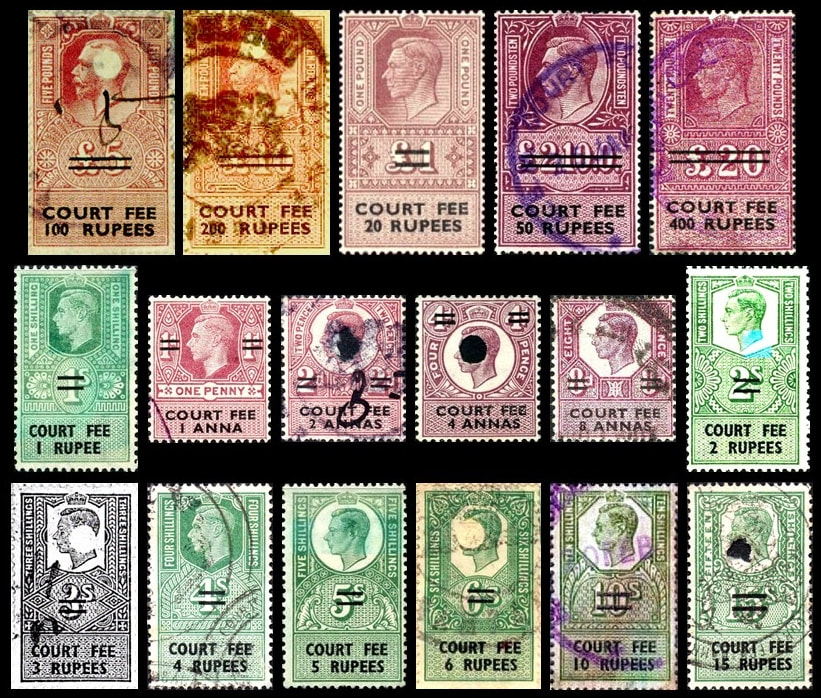
Top row: C1/2, C23/27; middle and bottom rows: C15, C11/14, C16/22
1948-57 (see note 1). Unappropriated die adhesives of Great Britain bearing the royal portrait, inscribed COURT FEES and surcharged in Indian currency, with bars through the original sterling value. 18½ x 22 mm (anna values), 22½ x 38 mm (20r to 400r) or 18 x 31 mm (others). Perf 14 x 15 (20r to 400r) or perf 15 x 14 (others). Watermark Multiple Orb and IR (=Inland Revenue). Printed (recess) by Somerset House.
a) Portrait of King George V
C1. 100r on £5 purple and black
C2. 200r on £10 purple and black
b) Portrait of King George VI
C11. 1a on 1d purple and black
C12. 2a on 2d purple and black
C13. 4a on 4d purple and black
C14. 8a on 8d purple and black
C15. 1r on 1s green and black
C16. 2r on 2s green and black
C17. 3r on 3s green and black
C18. 4r on 4s green and black
C19. 5r on 5s green and black
C20. 6r on 6s green and black
C21. 10r on 10s green and black
C22. 15r on 15s green and black
C23. 20r on £1 purple and black
C24. 50r on £2.10s purple and black
C27. 400r on £20 purple and black
Notes:
1. The dates of issue are derived from the registration dates in the Inland Revenue Stamping Department's archives, as quoted by Booth. The 1a to 20r values were registered on 19th October 1948, and were probably issued by the end of the same year. The 50r KGVI plus the 100r to 400r KGV were registered on 13th June 1950 and the remaining KGVI high values on 12th April 1957 (Booth queries the registration date of the 400r). Booth notes that the 1a, 100r, 200r and 400r were registered again in late 1957 for reprints - the 100r and 200r on 20th October, the 1a and 400r on 4th December.
2. In addition to the above values Barefoot (following Booth) lists the following similar values which I have not seen:
- King George V portrait: 400r on £20
- King George VI portrait: 100r on £5 and 200r on £10, plus two values in new decimal Indian currency - 25np on 3d and 50np on 6d (both registered on 28th October 1957)
3. Barefoot lists twelve more values similar to the above issue but with the portrait of Queen Elizabeth II: 25np, 50np, 1r, 2r, 5r, 10r, 15r, 20r, 50r, 100r, 200r, 400r (top two values issued 1967, others 1959), also three values with the currency shown as paise: 6p on 1d, 12p on 2d, 25p on 3d (all issued 1962). I have not seen any of these stamps and would be very pleased to hear from any reader who can illustrate them.
4. The Trucial States ceased to exist as an entity on 1st December 1971. For later revenue issues see United Arab Emirates.
a) Portrait of King George V
C1. 100r on £5 purple and black
C2. 200r on £10 purple and black
b) Portrait of King George VI
C11. 1a on 1d purple and black
C12. 2a on 2d purple and black
C13. 4a on 4d purple and black
C14. 8a on 8d purple and black
C15. 1r on 1s green and black
C16. 2r on 2s green and black
C17. 3r on 3s green and black
C18. 4r on 4s green and black
C19. 5r on 5s green and black
C20. 6r on 6s green and black
C21. 10r on 10s green and black
C22. 15r on 15s green and black
C23. 20r on £1 purple and black
C24. 50r on £2.10s purple and black
C27. 400r on £20 purple and black
Notes:
1. The dates of issue are derived from the registration dates in the Inland Revenue Stamping Department's archives, as quoted by Booth. The 1a to 20r values were registered on 19th October 1948, and were probably issued by the end of the same year. The 50r KGVI plus the 100r to 400r KGV were registered on 13th June 1950 and the remaining KGVI high values on 12th April 1957 (Booth queries the registration date of the 400r). Booth notes that the 1a, 100r, 200r and 400r were registered again in late 1957 for reprints - the 100r and 200r on 20th October, the 1a and 400r on 4th December.
2. In addition to the above values Barefoot (following Booth) lists the following similar values which I have not seen:
- King George V portrait: 400r on £20
- King George VI portrait: 100r on £5 and 200r on £10, plus two values in new decimal Indian currency - 25np on 3d and 50np on 6d (both registered on 28th October 1957)
3. Barefoot lists twelve more values similar to the above issue but with the portrait of Queen Elizabeth II: 25np, 50np, 1r, 2r, 5r, 10r, 15r, 20r, 50r, 100r, 200r, 400r (top two values issued 1967, others 1959), also three values with the currency shown as paise: 6p on 1d, 12p on 2d, 25p on 3d (all issued 1962). I have not seen any of these stamps and would be very pleased to hear from any reader who can illustrate them.
4. The Trucial States ceased to exist as an entity on 1st December 1971. For later revenue issues see United Arab Emirates.
Acknowledgments
R G Booth, A priced check-list of the U.K. G.VI unappropriated die adhesive revenue stamps (privately published, 2000)
J Barefoot Ltd, British Commonwealth Revenues (9th Edition, privately published, 2012)
R G Booth, A priced check-list of the U.K. G.VI unappropriated die adhesive revenue stamps (privately published, 2000)
J Barefoot Ltd, British Commonwealth Revenues (9th Edition, privately published, 2012)
